5 Hard Truths About Commodity Tracking & Costing
At TradeBeyond’s Q2 2026 Hong Kong Sourcing Leadership Roundtable, 30 sourcing leaders discussed cost volatility, commodity tracking, supplier transparency, and practical AI use cases.

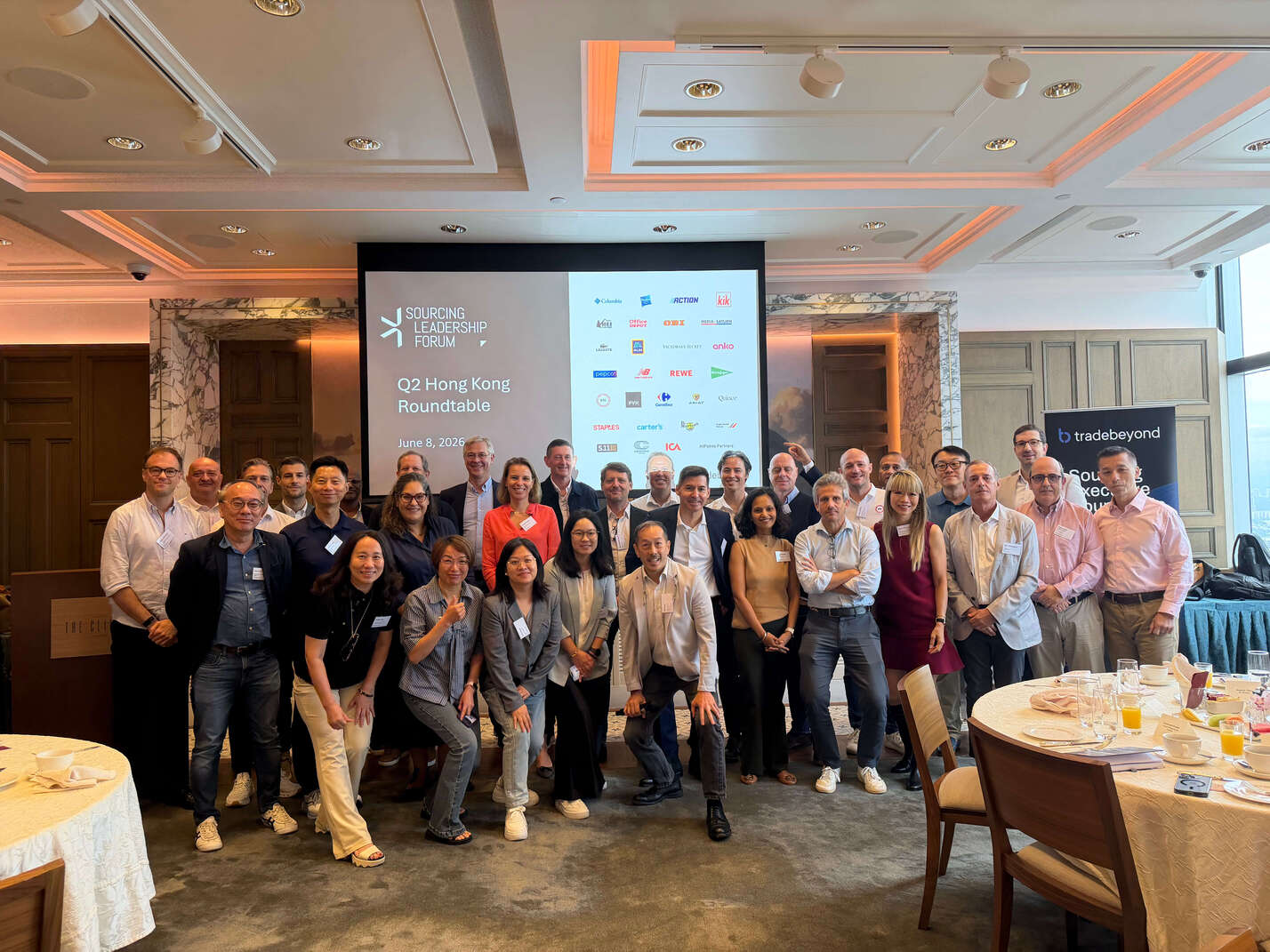
A room of 30 sourcing leaders — heads of global supply chain from brands like Hasbro, IKEA, PVH, New Balance, Office Depot, and Carrefour — gathered over coffee at 8:15 on a Monday morning to discuss one of the most persistent headaches in retail: how do you stay on top of costs in an ever-changing global environment?
That was the scene at our Q2 2026 Hong Kong Sourcing Leadership Roundtable. The morning featured a first-of-its-kind format: an AI-powered pre-event survey that conducted individual interviews with each attendee before they walked in the door. The insights that emerged — on commodity tracking and costing were candid and practical.
1. The Data Trap: 70% Gathering, 30% Thinking
If there was one number that stood out amongst the discussions, it was this one. When the AI survey aggregated responses from 29 participants, a pattern emerged: most sourcing teams are spending most of their time collecting and reconciling data and very little time using it. The cause for this gap is largely due to fragmented systems, parallel spreadsheets, and supplier inputs that don't connect to product costs in any automated way.
The good news: participants broadly agreed this is solvable. Automation and AI integration were cited as the clearest path forward, with around 40% of participants actively focusing on automating data collection as a priority improvement area.
2. Commodity Tracking: Everyone's Doing It, But Not Everyone's Getting Value
Crude oil up 52%. Copper up 15.5%. Cotton up 18.5%. Polyester up 5.5%. If you're a sourcing professional in 2026, these numbers will keep you up at night.
When the group assessed their commodity tracking maturity on a 1–7 scale (built bottom-up from their own responses, not imposed top-down), the results clustered in the middle: most participants rated themselves as "developing" to "competent." Only one participant qualified as a true expert.
The common thread during the roundtable discussions is that what separates competent from expert isn't about access to data. It is related more to automation and what you do with the data once you have it.
"The key gap is having no automated link between commodity tracking and product costing. Success is measured by tracking price changes and renegotiation ability — but the next level is making those connections automatic."

There was lively debate about whether every organization even needs to be an expert. A "best fit" perspective emerged, particularly for businesses where one or two commodities dominate the cost structure.
"It's an 80/20 approach. I'm in the baby world — 80% is cotton, 20% is poly. So when cotton goes up, I know exactly what that means for AUC. That's what I need."
For more complex product categories — DIY equipment, electronics, consumer hardware — the math gets exponentially harder. As one participant from the consumer electronics space noted, tracking the cost impact of individual components across tens of thousands of SKUs isn't just difficult. It might be impossible.

3. Supplier Transparency: The Elephant in the Room
One theme elicited the most active discussion in the room - you can build the best cost model in the world, but if your suppliers' numbers are not reliable, your outcome will also be flawed.
Supplier transparency was the most negatively rated topic in the AI sentiment analysis, with 44% of responses skewing negative. Participants described a wide spectrum of supplier behaviors — some providing detailed component-level breakdowns, others simply presenting top-line price increases with little justification.
"Supplier cost breakdown transparency varies — some provide detail, others push top-line increases. My suppliers use estimates, and the quality of those estimates impacts my numbers. I have to use my own connections and market intelligence to validate and adjust."
Several participants described building their own cross-checks using raw material contacts, industry benchmarks, and peer networks rather than taking them at face value. The implication is clear: until supplier data quality improves, sourcing teams are compensating with significant manual effort.
One practical approach that resonated: pre-negotiating cost adjustment frameworks with suppliers, creating a shared formula for how costs should change when commodities move. When both sides agree on the inputs and the mechanism upfront, individual negotiations become less contentious — and more predictable.
4. Costing Processes Are Holding — But Showing Their Age
With the turbulence surrounding tariff swings, logistics and geopolitical shocks, you might expect sourcing leaders to describe their costing processes as broken. But they didn’t. Instead, what emerged was more nuanced: the foundation is solid, but the infrastructure around it is weak.
"Costing process has been relatively robust through recent volatility. We're not making major changes — we're improving what we do, not rethinking it from scratch."
Negotiations and RFQ processes remain near-universal (close to 100% completion across participants). Where organizations diverge is in the higher-order capabilities: open-book costing with suppliers, formal should-cost models, scenario planning, and AI-assisted analysis. These were the areas where capability varied most widely.

An interesting debate broke out around KPIs and who is actually measuring cost performance well.
"In an inflationary year, I could be fishing every day and still generate cost savings — that doesn't mean I'm doing a good job. We established a Sourcing Price Index: a baseline that tracks where costs should go given commodity movements. The measure of success is how much your team beats that line."
Other KPIs that came up:
Cost mitigation (not just cost savings),
Responsiveness to macroeconomic conditions,
Margin improvement at a constant selling price, and most importantly,
Sell-through rate
Several participants noted that an over-focus on cost savings can inadvertently drive quality compromises that hurt sell-through downstream.
There was also strong agreement that the industry needs to move from FOB-centric thinking toward full landed cost — and eventually total cost of ownership including inventory carrying costs. As one participant put it: "We all work quite a lot on FOB costing. We're not yet there on full landed cost. That's the next frontier."
5. AI: High Optimism, Early Days
It's impossible to talk about sourcing in 2026 without talking about AI. And in this room, sentiment around AI and future tools was the most positive of any topic: 75% of responses skewed positive.
But optimism and adoption are different things. The reality described by participants is that most organizations are still in exploration mode — interested in AI-assisted costing, but not yet deploying it in any systematic way. A handful of participants had begun integrating AI tools; the majority were in "how do we learn more" mode.
Two practical use cases that generated the most excitement:
Automated cost breakdown updates tied to real-time commodity data
AI-assisted variance explanations ("why is my cost different from where I predicted?")
The Bottom Line: 5 Things Sourcing Leaders Should Be Doing Now
Based on the discussion and the AI-generated recommendations from the pre-event survey, these were the clearest calls to action:
Build systematic cost breakdowns across all major categories — not just apparel. Connect commodity movements to product cost in a structured, repeatable way.
Automate data collection first. The ROI on shifting from 70% gathering to 70% analysis is massive. Start with commodity indices that have APIs and feed them directly into your cost models.
Pre-negotiate cost adjustment frameworks with key suppliers. Agree upfront on what a 10% cotton increase means for your FOB. Remove the negotiation friction before it's needed.
Move toward landed cost and total cost of ownership. FOB is a starting point, not a destination. Logistics, inventory, and end-of-life costs need to be in the model.
Pilot AI on a bounded use case this quarter. Supplier feedback surveys, cost variance explanation, or automated commodity alerts are all manageable starting points that don't require an enterprise overhaul.
Join the Conversation
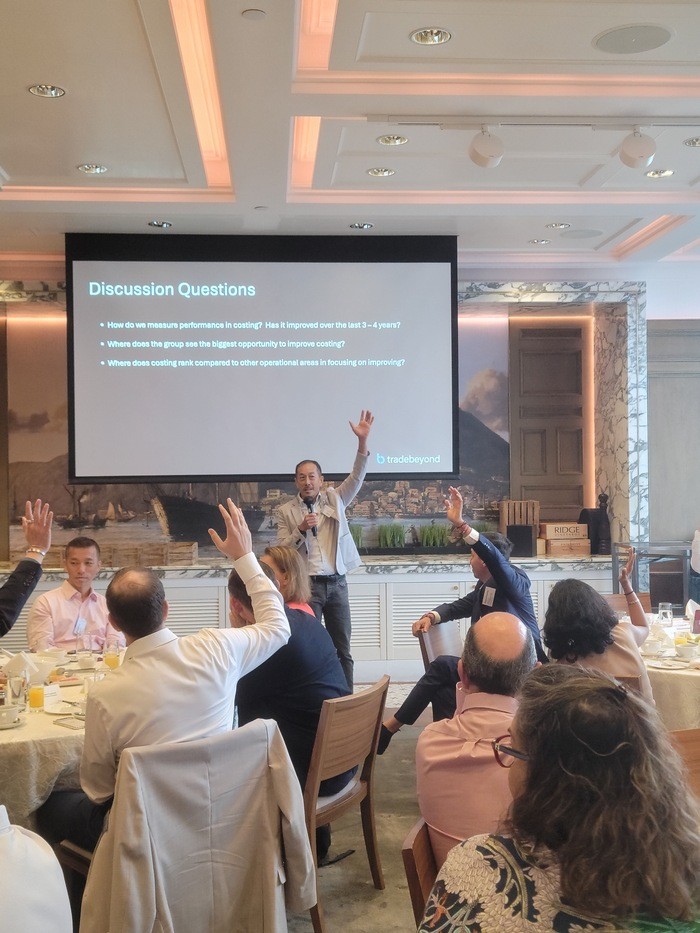
These roundtables happen quarterly in Hong Kong, with sessions also planned in New York, London, Amsterdam, and LA. Attendance is by invitation — curated for management-level professionals in sourcing, supply chain, and procurement at brands and retailers.
Upcoming events in Hong Kong:
Happy Hour — Hong Kong, August 27, 6:30–8:30 PM (Central)
Q3 Roundtable — September 7, 8:15–10:30 AM
Global Sourcing Summit — November 11, 9 AM–5 PM (300+ attendees, C-level focus)
Want to attend a future session in Hong Kong or other regional events?
Register Your Interest!
Table of Contents
Subscribe to the Newsletter
More Articles

Article
What Denver’s AAFA Event Taught Us About Traceability
Explore three takeaways from AAFA 2026 on supply chain traceability, due diligence and the reliable data brands need to meet evolving regulations.

Article
Apparel Sourcing in 2026: De Minimis, CAFTA-DR, and Section 301
Explore how de minimis changes, CAFTA-DR rules, and Section 301 tariffs are reshaping apparel sourcing, trade compliance, and supply chain strategy.

Article
DPP and ESPR: A Definitive Guide to the EU Digital Product Passports (DPP) and ESPR
Learn what the EU Digital Product Passport and ESPR require, who must comply, the 2026–2030 timeline, key data fields, and how brands can prepare.
Get in contact with one of our experts
" height="32px" id="vQcZRDBpx" width="32px"/></svg>)
Unify people, data, and processes to simplify global operations
Empower smarter, faster decisions that drive growth and profit
Build resilient, responsible networks for a changing world