AI is transforming retail PLM, sourcing, and production
AI transforms PLM and factory workflows with intelligent sourcing, predictive scheduling, and automation that reduces manual labor.
Product Management
Sourcing & Costing Management
Quality Management
Sustainability & Compliance Management


The fear that robots will one day take our jobs is ubiquitous. And factory workers are no different, with technology set to shift the current model to such an extent that the supply chain as we know it may soon cease to exist.
The entire aim of the automation revolution is to eventually replace humans on the factory floor with robots, and therefore allow the manufacturing model to move away from low-cost labour countries towards those that are geographically closer to the end market.
On one hand this puts a staggering 231 million jobs in 50 countries at risk in apparel manufacturing alone, according to a new report by McKinsey, called The Apparel Sourcing Caravan’s Next Stop: Digitization. But on the other, it allows the entire retail industry to restructure its product development, sourcing, data and operations, reduce transport costs and emissions, build up a skilled human workforce that treats labourers more fairly, and focuses closely on individual customer needs.
The AI in smart machines currently manages the more traditional repetitive tasks; however, this is advancing very quickly and we will soon witness a movement to full autonomous intelligence, where machines are able to learn enough to make recommendations that humans can trust.
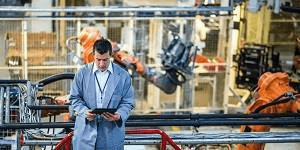
Factory owners are behind this evolution – 92% of senior manufacturing executives believe that Artificial Intelligence will enable them to increase their productivity levels and empower staff to work smarter. Although a recent survey by Boston Consulting Group found that a significant gap lies between an organisation’s ‘ambition and execution’, with only one in five companies currently incorporating AI into one or more of their processes. Similarly, global research firm, Forrester says that 58% of business and technology professionals are researching AI systems, yet only 12% are actively using them.
Edward Hertzman, the founder of the Sourcing Journal, believes we won’t see major change for the next few years, instead predicting industry-shifting geographic relocations within the next two decades. “In the next five years I don’t see much change,” he says. “Factories will upgrade facilities to make them more efficient and not as reliant on people but that’s about it. But in the future, if we get to the perfect solution, everything will be made by AI close to market, which means there will be no inventory at all, as all everything will be made on request. This will transform the way we manufacture products globally.”
And while this may sound like a bleak prognosis for many workers, the retail sourcing revolution should in fact improve labour conditions, placing a higher emphasis on skills and training.
“I am not so worried about jobs lost in manufacturing, as new jobs will be created when we transform along the current trajectory,” says Wilkie Wong, the managing director of global sourcing for the Esquel Group, which produces garments for brands such as Ralph Lauren, Tommy Hilfiger and Nike.
“In the factories, we will need more engineers and technicians supporting the workers. We will need more analysts and data scientists to study the data. Also, if we become more competitive, our business will also grow, thereby allowing us to redeploy our people to areas where they are most needed.”
Perhaps, instead of worrying about a robotic takeover, we need to embrace it and make humans and machines into safe, efficient teammates. “I think one thing that is sometimes lacking from the discussion is that AI is not a technology that’s out of our control,” says MIT researcher Julie Shaw, in an interview of the Technology Review. “We are the designers of the AI. How we frame the problem changes what AI can produce.”
Table of Contents
Subscribe to the Newsletter
More Articles

Article
What Denver’s AAFA Event Taught Us About Traceability
Explore three takeaways from AAFA 2026 on supply chain traceability, due diligence and the reliable data brands need to meet evolving regulations.

Article
Apparel Sourcing in 2026: De Minimis, CAFTA-DR, and Section 301
Explore how de minimis changes, CAFTA-DR rules, and Section 301 tariffs are reshaping apparel sourcing, trade compliance, and supply chain strategy.

Article
DPP and ESPR: A Definitive Guide to the EU Digital Product Passports (DPP) and ESPR
Learn what the EU Digital Product Passport and ESPR require, who must comply, the 2026–2030 timeline, key data fields, and how brands can prepare.
Get in contact with one of our experts
" height="32px" id="vQcZRDBpx" width="32px"/></svg>)
Unify people, data, and processes to simplify global operations
Empower smarter, faster decisions that drive growth and profit
Build resilient, responsible networks for a changing world