Digital Product Passports: Is Your Product Data Ready?
The passport is what shoppers see. The data behind it decides whether you can keep selling in Europe. Key takeaways from TradeBeyond’s live webinar with EON, and hosted by AAFA.

Picture a wool sweater on a shelf in Paris, sometime in 2028. A shopper scans the QR code on its label and sees where the wool came from, how to mend a snag, and a one-tap option to resell it when she’s done. A customs officer scans the very same code and sees something else entirely: a verified audit trail stretching back through every supplier tier and even the shipping routes
That scan takes two seconds. Building what sits behind it can take eighteen months.
At TradeBeyond, we have heard from some brands that they thought DPP was simply a QR code project. But the QR code is just the tip of the iceberg, the data needed beneath the surface is the other 90%.
In this webinar, “The DPP Countdown: Is Your Product Data Ready?”, TradeBeyond’s Angela Rhea, VP of Product and Indsutry Consultant, made the case to 600+ top global brands that DPP is a data project, not a labeling project. Joining Angela, we invited Natasha Franck, CEO and Founder of EON, to provide insights on what DPP looks like in practice, and share some fantastic case studies. Special thanks to AAFA for hosting this webinar with TradeBeyond.
Watch the webinar recording here.

For context, Angela opened with the line that framed the whole hour:
“Every product is becoming two things: the item and the data that proves it.”
— Angela Rhea, TradeBeyond
Two companies, two halves of one passport
Think about how a real passport works. Someone has to verify your birth certificate, your address and your identity documents. Someone else issues the booklet and decides what each border agent gets to see. A DPP needs both jobs done, and that’s exactly where these two companies divide the work.
TradeBeyond gets the data right: it collects, verifies and unifies item, supplier and batch data from across a multi-tier supply chain into one system of record. EON lets the world use it: it turns that data into a secure digital identity and a passport experience that shoppers, customs officials, resellers and recyclers can each access in their own way.
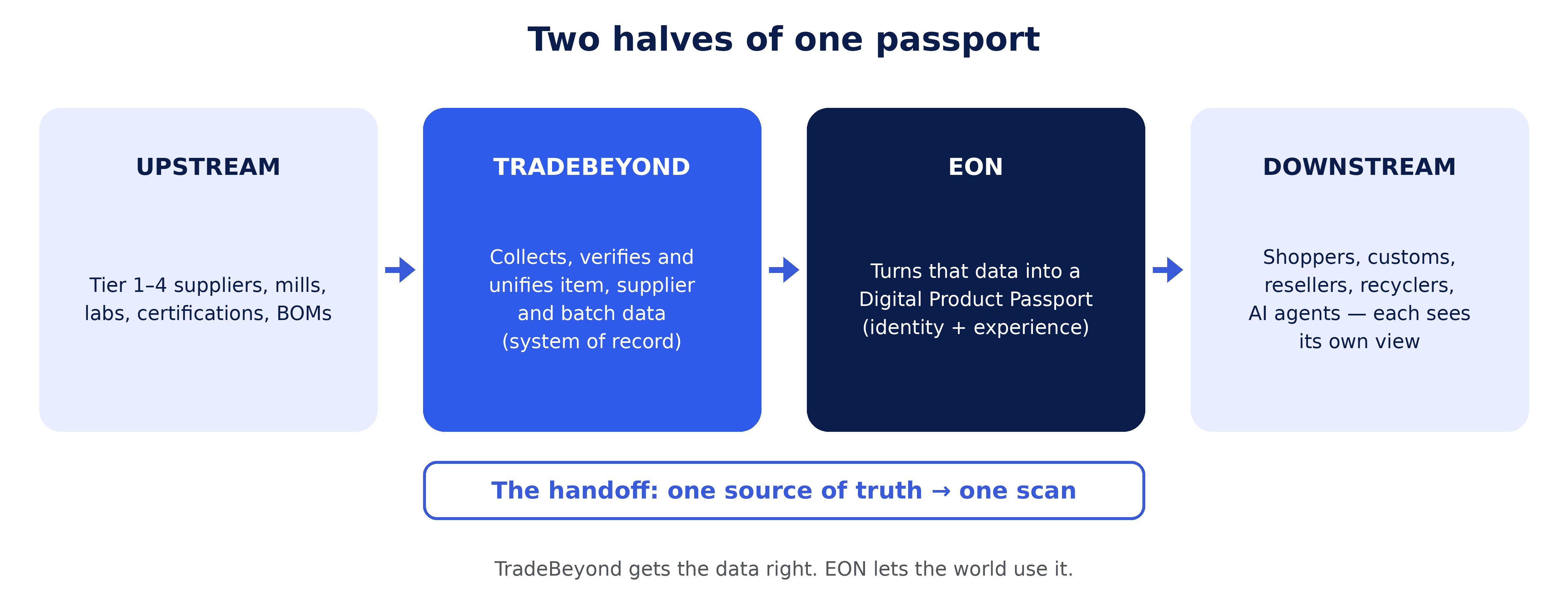
How TradeBeyond and EON fit together, from supplier to scan
Learn more about how TradeBeyond makes DPP and ESPR compliance easy.
Five takeaways every brand should hear
1. The mandate date isn’t your deadline
The regulatory calendar is filling up fast. The EU’s battery DPP arrives in February 2027, and it reaches further into apparel than it sounds (think sneakers or accessories with lights). The EU Deforestation Regulation touches leather. Textile DPP requirements are expected around 2028. But Angela warned that the date on the calendar is misleading:
“Your real deadline is however long it takes to collect, verify, and connect the data across every tier that it touches.”
— Angela Rhea, TradeBeyond
For most enterprises with multi-tier supply chains, that means 12 to 18 months of supplier engagement, data governance and systems integration before you’re even ready to test. A live poll showed where the room stood: 42% had begun mapping suppliers, and 37% hadn’t started at all.

Key slide: the regulatory clock is closer than it looks
2. The QR code is the tip of the iceberg
Angela described the scan as the visible 10%. Beneath the surface sits seven data categories, from material composition and origin to reparability and chain of custody, and almost none of them live inside the brand. They sit with mills, Tier 1 facilities, testing labs and upstream suppliers you may never have mapped. Yet if you’re the importer of record, you’re accountable for all of it.
Angela’s own mapping of the anticipated requirements points to more than 100 data attributes per product, multiplied across every SKU and purchase order. A five-component garment isn’t one data request; it’s many. And that load lands on suppliers who are already rekeying the same facts into a different system for every customer.
“Your suppliers are buried in data entry, and if this is news to you, they’re either not telling you or you’re not listening.”
— Angela Rhea, TradeBeyond
3. Master data is a photograph. A passport is a film.
Natasha, whose company, EON, is a technology partner in the EU Commission’s CIRPASS-2 DPP pilot program, described the deeper shift underway. Today, “100% cotton” sits in a flat field in a product record. A passport links that sweater to a specific cotton, a specific facility and a full audit trail, all connected in what the EU calls a knowledge graph. And the data never stops moving.
“Master data today is static. It’s like a photograph, but your product has a life cycle.”
— Natasha Franck, EON
A product gets resold, repaired and recycled. Today it belongs to Jessica; tomorrow it belongs to Paul. The passport has to keep up. Role-based access means each viewer sees only what they’re permitted to see, so your trade secrets stay protected while a customs official gets the full paper trail.
4. Compliance is the floor, not the ceiling
The data you build for the regulator is the same data that sells the product a second time. Natasha pointed to a major global retail chain store, which has introduced passports on more than 35 million products, including one-click resale to Poshmark. Chloé, Zalando and Coach’s Coachtopia are already using passports for care, resale and even digital ownership.
The economics are compelling. Bain & Company research suggests DPPs could double a product’s lifetime value, and with 70% of Gen Z thinking about resale before they buy, that option turns into loyalty. One shopper using an EON client’s resale feature said they were more likely to buy from the brand precisely because they knew they could always resell. The catch? Passports have to be worth scanning. As Natasha put it, “People don’t just want to view static content.”
“Product identity is going to be an entirely new value driver for the business.”
— Natasha Franck, EON
5. Start with a system, not a checklist
Angela reminded the audience that brands already hold far more than they think:
“Most of what DPP needs isn’t missing, it’s just scattered.”
— Angela Rhea, TradeBeyond
Bills of materials, specs, material libraries and audit files already exist; they’re just spread across teams and tools. The job is to connect what’s there before asking suppliers to re-enter anything. Natasha added that because requirements will keep evolving, brands should approach DPP “as a systems view rather than a checklist of data.” The speakers mentioned that some enterprise clients have 40-person stakeholder groups spanning the CIO, labeling and marketing.
5 DPP actions you can start now
The speakers closed with five moves you can make next Monday:
Map which regulations hit which products, in which markets.
Name your Tier 3 suppliers.
Take inventory of the data you already hold.
Find the fields with no owner and no source.
Choose your system of record, and then your presentation partner.
From the Q&A
The audience questions showed just how real these concerns are. A few highlights:
Q: Who’s responsible for DPP compliance: the brand, the supplier or the importer?
Whoever is the importer of record owns it. That holds for private-label manufacturers too. If you import the goods, the data is yours to gather.
Q: What happens if we’re not ready when a DPP or ESPR mandate hits?
The price of noncompliance is market access.” That could mean goods held at customs, recalls or significant fines. For some brands, that’s billions in EU revenue at stake.
Q: How do we get data for DPP from Tier 3 and 4 suppliers we don’t work with directly?
Work through your Tier 1 partners, and set a clear brand policy that a traceable supply chain is required. Most of all, tell suppliers early. “The more runway you can give them, the more successful they’re going to be,” Angela said.
Q: Is DPP only for the EU?
For now, yes. There’s no US DPP law, but expect a US version to show up first as digital care labeling. Brands are already using location-aware QR codes to show different content in New York, Mexico City or Paris.
Catch the full conversation
This recap only scratches the surface. The full recording includes the CIRPASS-2 pilot details, live brand examples and every audience question, and it’s available now at TradeBeyond’s On-Demand webinar page.
Access the on-demand webinar to view the live recording here.
Want to learn more about TradeBeyond’s DPP offerings? Check it out here.
Ready for a tailored DPP demo with our team? Fill out the form below.
Interested in enabling DPP compliance for your business? Get a demo from our DPP experts.
Table of Contents
Subscribe to the Newsletter
More Articles

Article
The Life of a Jacket: How Digital Product Passports Will Change What Happens After You Buy
Learn how Digital Product Passports connect product and supply-chain data to support traceability, circularity, resale, repair and recycling.

Article
What Does the Next Generation Sourcing Organization Look Like?
Discover four takeaways from TradeBeyond’s Q3 Sourcing Leadership Forum on AI readiness, exposure metrics, AI literacy and stronger sourcing collaboration.

Article
Beyond the Scorecard: Closing the Performance-to-Decision Gap
Connect supplier performance, risk and business context to identify meaningful changes, guide corrective action and improve sourcing decisions over time.
Get in contact with one of our experts
" height="32px" id="vQcZRDBpx" width="32px"/></svg>)
Unify people, data, and processes to simplify global operations
Empower smarter, faster decisions that drive growth and profit
Build resilient, responsible networks for a changing world