
If your Q2 numbers looked like strong, organic growth, you might want to look a little closer. Across the industry, a significant portion of that manufacturing growth was actually front-loading and precautionary stock-building ahead of anticipated price hikes.
As we progress through the second half of 2026, the global supply map isn't just shifting - it's fracturing. Supply chains originally built purely for efficiency are now operating in a world shaped by geopolitical conflicts, unresolved trade agreements, and accelerating regulations.
The defining trend we're seeing across our network of global retailers is a permanent pivot from cost optimization to resilience optimization.
The Freight Reality Check
First up - let's talk logistics. Container freight rates have hit 18-month highs right as peak season begins. This isn't a temporary blip; it's the compounding result of Red Sea diversions, early peak season demand, and shippers aggressively trying to get ahead of shifting tariff landscapes.
While our base case for Asia to the U.S. West Coast sits between $3,000 and $3,800 per FEU, disruption scenarios are pushing those numbers past the $5,000 mark.
Combine this with unsettled commodity markets, including sharp price swings across crude oil, metals, and cotton - and the need for ironclad Q4 planning becomes obvious. Sourcing teams can no longer rely on single-carrier dependence.
The "China+1" Strategy is Showing Hard Numbers
We've all talked about diversifying sourcing networks, but the data shows it's finally happening at scale. India has officially overtaken South Korea to enter the global top five manufacturing powers, with output reaching nearly $493 billion. At the same time, Vietnam is aggressively moving beyond low-cost assembly, transitioning into complex, high-value ecosystem building. The map is being rewritten in real-time.
Policy, Compliance, and the End of "Wait and See"
Beyond logistics and locations, the regulatory landscape is tightening its grip. Extended Producer Responsibility (EPR) isn't just a future concept to prepare for - enforcement is live. Mixed-material products are going to cost you more to sell under new eco-modulated fee structures.
Additionally, the U.S. recently declined to renew the USMCA as-is, opening the door to an open-ended period of renegotiation that will impact North American supply chains for years to come.
Foresight, Not Hindsight
Navigating this level of volatility requires more than just reacting to the news cycle. In our 56th quarterly edition of the TradeBeyond Retail Sourcing Report, you'll find the macroeconomic indicators, commodity rates, and trade policy updates behind these shifts across 30+ manufacturing economies.
It's the high-level market intelligence you need to execute your long-term planning and ensure your Q4 landed-cost assumptions still hold up.
Get my copy of the TradeBeyond Retail Sourcing Report Q3, 2026
Why trust this data? TradeBeyond has been the quiet digital backbone behind the world's leading brands for over a decade. We didn't just arrive with the latest SaaS or AI hype wave - we've spent 30 years shaping supply chain technology from the ground up. Reader requests and real-world supply chain data have shaped this report for 56 straight quarters.
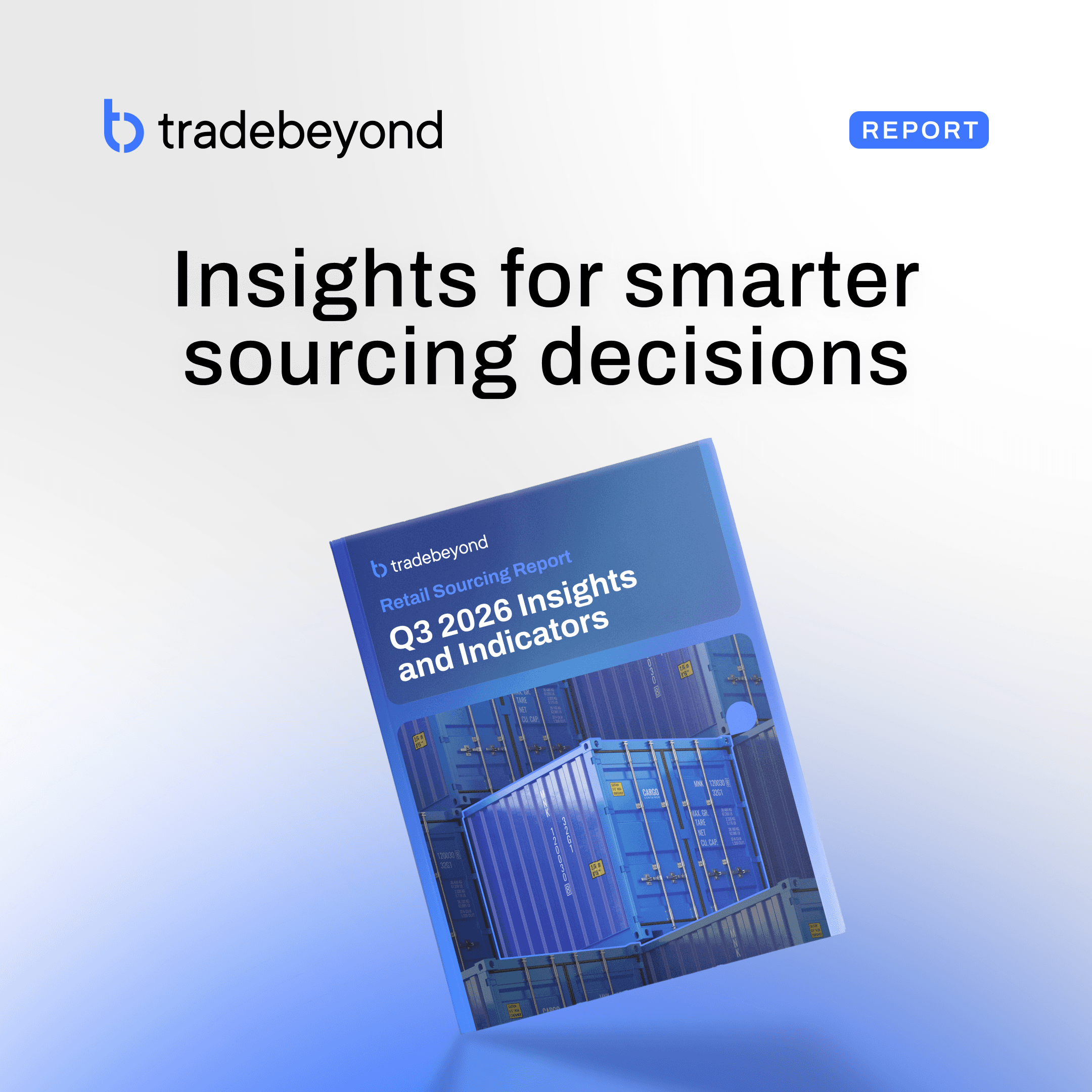
Table of Contents
Subscribe to the Newsletter
More Articles

Article
Defect Classification: How to Build a Critical, Major, and Minor Defect System
How to build a defect classification system - critical, major, and minor defect definitions, AQL thresholds, category examples, and enforcement at scale.

Article
Digital Product Passports: Is Your Product Data Ready?
Learn why DPP readiness is a data project, not a QR code project, with insights from TradeBeyond and EON on compliance, traceability and circularity.

Article
The Life of a Jacket: How Digital Product Passports Will Change What Happens After You Buy
Learn how Digital Product Passports connect product and supply-chain data to support traceability, circularity, resale, repair and recycling.
Get in contact with one of our experts
" height="32px" id="vQcZRDBpx" width="32px"/></svg>)
Unify people, data, and processes to simplify global operations
Empower smarter, faster decisions that drive growth and profit
Build resilient, responsible networks for a changing world